How to Locate the Cookies Folder in Windows Vista

by Updated April 11, 2009

Finding Cookies in Windows Vista is a little trickier than you might think. Most cookies are found in the following folder location:

C:\Users\<user>\AppData\Roaming\Microsoft\Windows\Cookies\Low

So you can just type that into the windows address bar and it will come up, but make sure to replace <user> with your Computers username.  If you're not sure how to access the windows address bar, just open up the "Documents" folder and you'll see the address bar at the top (to the left of the search box).  Now you can just click on the address bar and replace "Documents" with "AppData\Roaming\Microsoft\Windows\Cookies\Low", and then hit "Enter" on your keyboard to quickly access most of the Cookies on your computer.

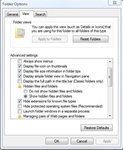
By default the Cookies folder is hidden, so to access the folder without typing in the location directly into the windows address bar, you need to show hidden files and folders.  To do this follow these steps:

  1. Click 'Start' -> then click on 'Control Panel'
  2. On the left side of the 'Control Panel' window, click on "Classic View"
  3. Now click on "Folder Options"
  4. In the "Folder Options" pop-up box, select the "View" tab
  5. Within "Advanced Settings", select "Show hidden files and folders".
  6. Also uncheck "Hide protected operating system files".  A "Warning" pop-up box will appear asking "Are you sure you want to display these files?", which you will want to click the 'Yes' button.
  7. To save your settings click 'Apply', then click 'OK'.

 Now you should be able to see and locate the 'Cookies' folder easily.


0
0

Add your comment

by Anonymous - Already have an account? Login now!
Your Name:

Comment:
Enter the text you see in the image below
What do you see?
Can't read the image? View a new one.
Your comment will appear after being approved.

Related Posts


Find out how to quickly and easily rename a group of files or folders at once.  more »

Here's a quick way to enable programs to 'Run as Administrator' in Windows Vista. Click on the 'Start' menu button, it's the blue circle located on the left-hand side of the Task bar. Now click on 'All Programs' Find the program you want to 'Run as...  more »

So here's a quick tip on how to fix the following SQL Server "SqlDateTime overflow" error. System.Data.SqlTypes.SqlTypeException SqlDateTime overflow. Must be between 1/1/1753 12:00:00 AM and 12/31/9999 11:59:59 PM. The reason that you are probably...  more »

After setting up a new Windows 7 computer with IIS 7.5 and Visual Studio 2010, I tried to start my ASP.NET 4.0 website using the Local IIS web server. However, right off the bat I was hit with the following IIS error message: HTTP Error 500.21 - Internal...  more »

This computer tip will help you quickly increase or decrease the size of text on a web page or in an email message for better viewing using a mouse click wheel.  more »

If you're making the jump to begin using the Windows Live Mail email client now in Windows 7, from the Windows Mail client that was on Windows Vista, you may want to transfer over your previously entered email account setup details that you had been using...  more »

Here's a step by step process to enable a remote connection to your SQL Server 2008 Express database that is configured on Windows Server 2008 using an assigned port #. 1) First make sure the SQL Server Authentication is enabled and the User name that...  more »

The new Routing features in ASP.NET 4.0 are pretty awesome. However, one issue I ran into recently was trying to get the fully qualified urls from Page.GetRouteUrl as string urls to be used in emails messages. Unfortunately, I wanted something that worked...  more »

Here's how you can enable SQL Server Authentication in a SQL Server 2008 database, and then add a User login and password account for connecting to the database. Open SQL Server Management Studio In the Object Explorer sidebar, right-click on the top SQL...  more »

MySQL has several ways to create backups of important data. In this article, I will show you how to create a backup of your MySQL database on a Windows machine using the MYSQLDUMP utility that is included with MySQL.  more »

ISO files contain the image of a disc, which is essentially an exact copy of the low level data actually stored on a disc. Typically, ISO image files have a file extension of .iso. When burning an ISO file to CD or DVD, you'll want to just make sure that...  more »

Here's a quick tip on how you can adjust the mouse pointer speed in Windows 7: Click Start menu, and then open Control Panel. Then click on Hardware and Sound. Now under Devices and Printers, click on Mouse. The Mouse Properties box should pop-up, click...  more »