How to Subscribe to Podcasts Using iTunes and RSS feeds

Learn how to manually subscribe to podcasts with iTunes.
by

Subscribing to a Podcast using iTunes can be accomplished in a couple of different ways.  One of the simplest ways is to open iTunes and go to the iTunes Store. From there you can either search for your favorite podcasts using the search box or find podcasts by going to the "Podcast" section using the iTunes store menu.  However, not all podcasts that you want to listen to are listed in the iTunes Store Podcast section, especially if the podcast is new.  So in this case, you may have to grab a Podcasts RSS feed and manually subscribe to the podcast within iTunes. Here's how to subscribe to a podcast manually in iTunes:

  1. Open iTunes.
  2. Copy the podcast URL feed (RSS) that you'd like to subscribe to, if it's a Feedburner URL you may be able to click on an iTunes link within the Feedburner feed that automatically imports the podcast into iTunes.  For instance in Andrew Wee's Feedburner feed there's an iTunes link: http://feeds2.feedburner.com/AndrewWeeBloggingAffiliateMarketingSocialTrafficGenerationInternetMarketing 
  3. Once you've copyied the podcast feed, go to iTunes and click on the "Advanced" menu at the top -> then click "Subscribe to Podcast..."
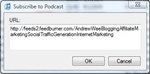
  4. In the Subscribe to Podcast pop-up box, simply paste in the podcast feed url that you copied and click "OK".
  5. If the url is a valid podcast feed it will begin downloading the latest podcast episode from the feed, and the podcast will now appear within the "Podcasts" section of iTunes.

You've just subscribed to a new podcast using the Advanced menu in iTunes!


0
0

Add your comment

by Anonymous - Already have an account? Login now!
Your Name:

Comment:
Enter the text you see in the image below
What do you see?
Can't read the image? View a new one.
Your comment will appear after being approved.

Related Posts


Taking the cover off of a Dell XPS 8000 computer can be a bit of a mystery if you have never removed it before. Here's how to open the case of a Dell XPS 8000 for the first time: At the back of the Dell XPS 8000 case, remove the screw just below the hand...  more »

I recently moved my sites over to a new web server that has "Windows Server 2008 R2" installed. The older server had just been running "Windows Server 2008". After moving my sites over I discovered that my AJAX Toolkit AutoComplete functionality had...  more »

You're not out of luck if the CD-rom drive on your desktop computer or laptop does not open when you push the button on the drive to eject the CD. You can manually open your computer's DVD or CD-rom drive using a paper clip when the computer is turned...  more »

Here's how to install Internet Information Services (IIS7) on a Windows 7 (or Vista) computer so that ASP.NET websites will run on the IIS7 web server. First, you will want to make sure that you are signed into an account with Administrator access on your...  more »

I just installed the URL Rewrite Module for IIS 7.0 and started playing around with how to setup rules to create search engine friendly URLs. The first rule I decided to setup was to redirect a site to the WWW sub-domain version when it was not typed in...  more »

If you've been using Windows Mail on a Windows Vista computer, and upgraded to a Windows 7 computer you may want to copy over your email information from Windows Mail to the newer Windows Live Mail email client on Windows 7. As it stands now Windows Mail...  more »

After setting up a new Windows 7 computer with IIS 7.5 and Visual Studio 2010, I tried to start my ASP.NET 4.0 website using the Local IIS web server. However, right off the bat I was hit with the following IIS error message: HTTP Error 500.21 - Internal...  more »

By default the Quick Launch bar is no longer enabled in Windows 7, which is where the Show Desktop shortcut icon button resided in previous version of Windows. Don't worry, the Show Desktop feature is still included in Windows 7, it's just been redesigned...  more »

At some point, you may need to disable Microsoft Security Essentials (MSE) in order to install other software. To disable MSE follow these steps: Open Microsoft Security Essentials Click on the Settings tab. In the left-hand menu, select Real-time...  more »

Here's a quick tip on how you can adjust the mouse pointer speed in Windows 7: Click Start menu, and then open Control Panel. Then click on Hardware and Sound. Now under Devices and Printers, click on Mouse. The Mouse Properties box should pop-up, click...  more »

In the following step by step, I will take you through the process of deleting existing hard drive partitions, formating and installing Windows XP on a hard drive using the Windows XP installation CD. Note: If you have any data/applications or drivers on...  more »

Recently, I decided to begin converting my Visual Studio.net Web Site Projects (WSP) to Web Application Projects (WAP) to take advantage of some of the new Web Deployment features in Visual Studio.net 2010 (see Vishal Joshi's blog for a run through of WSP...  more »